Model

Service Hotline

+86-13288788831

News Center

Introduction to common categories of fiber optic connectors
The technology in the network communication industry is constantly developing, and with the implementation of urban optical networks, in recent years, technologies such as fiber optic connectors, optical cables, and optoelectronic equipment have also seen better development and wider applications. As the core component of interconnect products, fiber optic connectors have naturally attracted people's attention. In fiber optic communication systems, the use of fiber optic connectors is also very large. It is an important connector electronic component used to connect and disconnect fiber optic signals. Below are some common fiber optic connectors:FC (F01) type fiber optic connectorThe FC type connector mainly adopts a metal threaded connection structure, and its pin body uses precision ceramic pins with an outer diameter of 2.5mm. According to the different shapes of its pin end faces, it can be roughly divided into two structures: FC/PC with spherical contact and FC/APC with oblique spherical contact. CJT connector technicians tell you that the FC type connector is currently the most widely used variety in the world and is also the main variety used in China. Two SC (F04) type fiber optic connectorThis is a molded plug-in coupled single-mode fiber optic connector, which has the same structural dimensions as the FC type, and the pin body is also a precision ceramic pin with an outer diameter of 2.5mm. In addition, its end face treatment adopts PC or APC grinding method; The fastening method is plug-in bolt type. This type of connector is inexpensive, easy to plug and unplug, with minimal fluctuations in connection losses, high compressive strength, and high installation density. Three ST type fiber optic connectorThe connector here adopts a key type bayonet locking structure (similar to BNC connection structure), and the pin body is a precision ceramic pin with an outer diameter of 2.5mm. In addition, the end face shape of the pin is usually PC surface.
2025-06-23 10:24
Science popularization and innovative design of professional application fields for board to board connectors
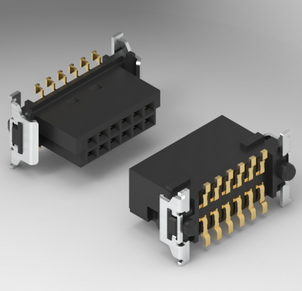
The widespread application of board to board connectors has emerged against the backdrop of electronic devices continuously moving towards miniaturization, integration, and high-speed development. The trend of domestic substitution of board to board connectors is becoming increasingly evident! This trend not only reflects changes in market demand, but also embodies the comprehensive role of technological progress and policy support. With the popularization and acceleration of electronic products, the requirements for connections between circuit boards are also increasing. Science popularization and innovative design of professional application fields for board to board connectors Segmented explanation of the application areas of board to board connectors:The application of board to board connectors is equally widespread. With the development of the Internet, the data center has become an important infrastructure. Board to board connectors are mainly used in data centers to connect servers, storage devices, network equipment, etc., achieving high-speed transmission and exchange of data. Due to the extremely high requirements for data transmission speed and stability in data centers, board to board connectors play a crucial role here. The field of medical instruments is also one of the important application areas of board to board connectors. With the development of medical technology, more and more medical instruments have entered households. Board to board connectors are mainly used in medical instruments to connect components such as power supply, signal transmission, and data storage, improving the safety and reliability of the instrument. For example, in an electrocardiograph, board to board connectors ensure accurate transmission and storage of electrocardiogram signals, providing doctors with accurate diagnostic basis. In addition, in remote medical systems, board to board connectors also play a key role, such as video calls, data transmission, etc., allowing patients to receive professional medical services at home, reducing medical and time costs. As an indispensable core component in modern electronic devices, board to board connectors will greatly change people's way of life and work with the promotion of 5G technology. In 5G communication systems, board to board connectors are mainly used to connect devices such as base stations, antennas, and terminals, achieving high-speed wireless signal transmission. The 5G communication system has extremely high requirements for the performance and reliability of connectors, as any minor malfunction can lead to communication interruption or data loss. Board to board connectors, with their high reliability and stability, ensure the normal operation of 5G communication systems and the accuracy of data transmission. With the rapid development of industrial automation, robots have been widely used in various production fields. Board to board connectors are mainly used in robots to connect components such as sensors, actuators, and control boards, achieving various functions of the robot. For example, in industrial robots, board to board connectors ensure accurate connection and communication between sensors and actuators, enabling the robot to perform precise operations according to preset programs. The stability and reliability of this connection method are of great significance for improving production efficiency and product quality. Precautions for using board to board connectors:Board to board connectors are divided into single slot, double slot, and side plug types, with the main characteristics of fast transmission speed, wide application range, and flexible installation. Board to board connectors need to pay more attention to details in application, otherwise it is easy to cause damage and affect the use of the product. Board to board connectors are a type of connector that generates heat during signal transmission after each insertion, resulting in loss and gradually weakening the performance of the connector. When the number of insertions and removals of board to board connectors reaches a certain level, the connector terminals will also wear out. If not maintained in a timely manner, it can lead to board to board connector failures. Qualification and Certification of Board to Board Connector Production and Wholesale SuppliersIndustry certification: Products must pass UL, CE, RoHS and other certifications to comply with international standards. Technical support: Suppliers are required to provide comprehensive services such as selection guidance, sample testing, and failure analysis. The localization of board to board connectors not only helps to reduce costs, but also promotes the independent and controllable development of the entire electronic industry chain, laying a solid foundation for the rise of Chinese manufacturing. Friendly reminder, when selecting board to board connectors, a comprehensive evaluation should be conducted from multiple dimensions such as technical parameters, application scenarios, and supplier qualifications to ensure that the product meets system requirements.

2025-06-23 10:23
Type-C Interface EMI Optimization: Collaborative Noise Reduction Scheme of Three Layer Shielding and Ferrite Magnetic Ring
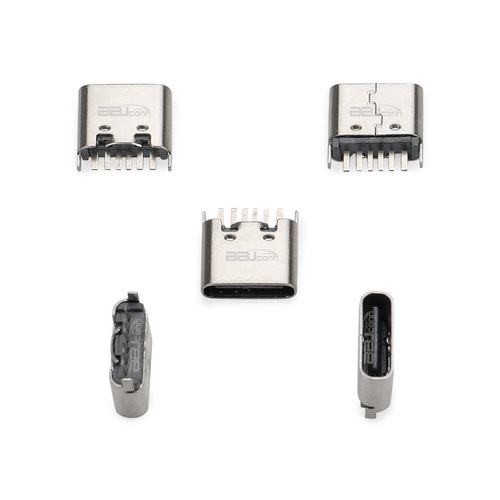
As the core connection standard of modern electronic devices, Type-C interface has higher requirements for electromagnetic compatibility (EMI) due to its high-speed transmission and high-power charging capability. With the increase of data transmission rate, the electromagnetic radiation problem of Type-C interface under high-frequency signals is becoming increasingly prominent, which may interfere with other electronic devices and even affect its own stability. To address this challenge, the industry has proposed an EMI optimization solution of "3-layer shielding+ferrite magnetic ring", providing an innovative path for the reliability of Type-C interfaces.The EMI problem of Type-C interface mainly stems from the fast switching of high-frequency signals and current fluctuations. Under USB 3.2 or Thunderbolt 4 protocols, the operating frequency of Type-C interface can reach tens of GHz, and crosstalk and common mode noise between signal lines are easily radiated to the external environment through cables. The traditional single-layer shielding design is difficult to completely suppress high-frequency radiation, while the "3-layer shielding" scheme significantly improves shielding effectiveness through a multi-layer isolation structure. The first layer of shielding covers the outer layer of the cable, blocking external interference; The second layer wraps the internal wire pairs to reduce signal crosstalk; The third layer provides independent shielding for power lines to prevent magnetic field leakage caused by high currents. This layered design gradually blocks the propagation path of electromagnetic radiation, reducing the EMI index of Type-C interface by more than 40%. The shielding effectiveness of Type-C interface needs to be further optimized by combining with ferrite magnetic rings. Ferrite magnetic rings are integrated into interface terminals or cables to suppress common mode noise through their high-frequency impedance characteristics. When high-frequency current passes through the Type-C interface, the magnetic ring absorbs electromagnetic energy in a specific frequency band and converts it into thermal energy for dissipation. For example, in the range of 10MHz to 1GHz, ferrite magnetic rings can attenuate common mode interference by more than 20dB. This dual mechanism of "active absorption+passive shielding" enables the Type-C interface to maintain a stable electromagnetic environment even during high-speed transmission above 5Gbps.The 3-layer shielding design of Type-C interface poses higher requirements for manufacturing processes. Each layer of shielding material needs to balance conductivity and flexibility, such as using a combination of aluminum foil Maillard layer, woven copper mesh, and polymer composite material. The aluminum foil layer provides basic shielding, the copper mesh enhances structural strength and expands shielding coverage, while the polymer material ensures the bending life of the cable. At the same time, the selection of ferrite magnetic rings needs to accurately match the operating frequency of the Type-C interface to avoid a decrease in filtering effect due to impedance mismatch. This refined design enables the Type-C interface to meet both the 40Gbps transmission requirements of USB4 and pass strict electromagnetic certification tests such as FCC and CE.The EMI optimization solution for Type-C interface is driving the upgrade of industry standards. The International Electrotechnical Commission (IEC) has included multi-layer shielding in the new version of the USB cable design guidelines, and the application of ferrite magnetic rings has also been included in the recommended specifications for some high-speed connectors. In the field of consumer electronics, manufacturers such as Apple and Samsung have adopted similar solutions in the Type-C interface of their flagship devices; In industrial scenarios, the vehicle mounted Type-C interface successfully addresses the electromagnetic interference challenge of high-voltage systems in electric vehicles through a "3-layer shielding+dual magnetic ring" design. These practices have shown that this solution not only enhances user experience, but can also be extended to more demanding application environments. The EMI control technology of Type-C interface will develop towards integration and intelligence in the future. With the introduction of new technologies such as silicone encapsulation shielding layers and nano magnetic materials, the shielding structure of Type-C interfaces may further become thinner and lighter while maintaining or even improving performance. In addition, the intelligent magnetic ring can adapt to the noise suppression requirements of different frequency bands by dynamically adjusting its impedance characteristics. This technological evolution will enable the Type-C interface to continuously meet the stringent EMI requirements of 6G communication and AI computing devices for high-speed connectors while maintaining a compact size. Through material innovation and design optimization, the Type-C interface will continue to consolidate its leading position as a universal connectivity standard.
2025-06-23 10:19
Special waterproof Type-C for deep-sea equipment: 20MPa pressure chamber tested 1000 times without failure after plugging and unplugging
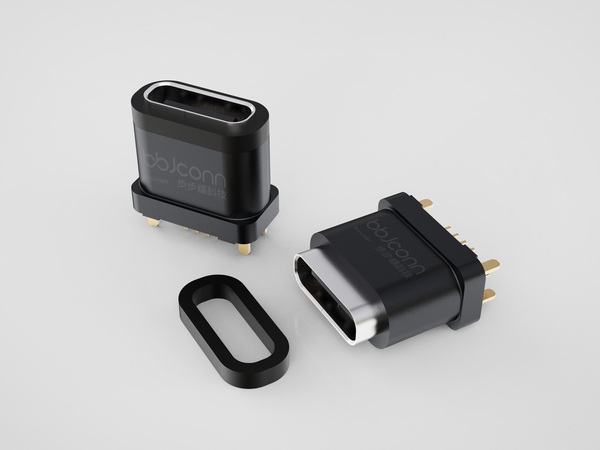
The application of Type-C interface in deep-sea devices is becoming an important breakthrough in the field of underwater technology. With the rapid development of ocean exploration and deep-sea exploration equipment, the reliability issues of traditional connectors in high-pressure, high salt, and high humidity environments are becoming increasingly prominent. In response to this challenge, the waterproof Type-C interface specifically designed for deep-sea equipment has achieved excellent performance without failure after 1000 insertions and removals in a 20MPa pressure chamber through innovative sealing design and material technology, providing a stable and durable connection solution for underwater equipment.The deep-sea waterproof performance of Type-C interface is primarily attributed to the multi-layer composite sealing structure. Through the integrated design of silicone sealing rings, nano coatings, and metal shells, the interface can still isolate seawater infiltration under extreme pressure. In the 20MPa pressure chamber simulation test, the sealing layer of the waterproof Type-C interface dedicated to deep-sea equipment can withstand external pressure equivalent to a depth of 2000 meters, while maintaining the integrity of signal transmission. This design not only solves the problem of aging of traditional rubber seals, but also extends the service life of the interface in salt spray environments through the anti-corrosion treatment of the metal shell.The mechanical durability of Type-C interface is another key indicator for deep-sea equipment applications. In 1000 cycles of insertion and extraction testing, the metal contacts of the interface are coated with gold and have an elastic self-cleaning structure to ensure low resistance connection even after repeated insertion and extraction. The test data shows that even after thousands of insertions and removals, the change rate of contact resistance is less than 5%, and the signal attenuation is controlled within 3dB. This breakthrough in performance enables the specialized waterproof Type-C interface for deep-sea equipment to handle long-term deployment and frequent maintenance of marine research tasks, such as applications in underwater robots, underwater observation stations, and other scenarios. The high voltage tolerance of Type-C interface cannot be achieved without precise structural simulation and material testing. The R&D team optimized the stress distribution of the interface through finite element analysis to avoid sealing failure caused by shell deformation under 20MPa pressure. At the same time, the shell material is a composite structure of titanium alloy and PEEK (polyetheretherketone), which balances lightweight and compressive strength. In the actual testing of the pressure chamber, no cracks or deformations occurred at the interface under extreme pressure, verifying the reliability of its structural design. This dual verification mode of "simulation+actual testing" provides technical support for the engineering application of waterproof Type-C interfaces specifically designed for deep-sea equipment. The electrical performance of Type-C interface has also been tested in deep-sea environments. By incorporating ferrite magnetic rings and double-layer shielded cables, the interface can effectively suppress electromagnetic interference (EMI) even in high voltage environments. Tests have shown that under a pressure of 20MPa, the transmission rate of the interface can stably support the 10Gbps standard of USB 3.2 Gen2, with an error rate of less than 1 × 10? 12. This performance enables it to meet the bandwidth requirements of scenarios such as underwater high-definition cameras and sonar data transmission, laying the foundation for the intelligent upgrade of deep-sea exploration equipment.The deep-sea adaptability of Type-C interface is driving the innovation of industry standards. The International Marine Engineering Association (IMCA) has included this type of interface in the "Technical Guidelines for Underwater Equipment Connectors", and its testing standards have been adopted by multiple research institutions. In commercial applications, Norwegian deep-sea robot companies have adopted waterproof Type-C interfaces in bulk to replace traditional wet plug connectors, reducing operation and maintenance costs by 40%; The Chinese "Jiaolong" scientific research team has also verified its reliability in experiments. In the future, with the development of emerging fields such as deep-sea oil and gas development and underwater data centers, the high-pressure waterproof technology of Type-C interface is expected to become a universal connection standard for underwater equipment.The technological evolution of Type-C interface will continue to focus on performance breakthroughs in extreme environments. For example, improving the oxidation resistance of contacts through graphene coating, or using intelligent sealing materials to achieve pressure adaptive dynamic sealing. These innovations will enable the specialized waterproof Type-C interface for deep-sea equipment to remain stable in deeper waters (such as the Mariana Trench) and more complex working conditions, providing stronger technical support for human exploration of ocean mysteries.
2025-06-23 10:15